Church Scarsdale
Uncle SilasChurch Scarsdale is a secluded Derbyshire landscape of abbey ruins and a churchyard, remembered chiefly as the setting where Madame de la Rougierre frightened Maud Ruthyn and where Maud later said she had encountered Dudley Ruthyn. Its solitude gives the first episode an unnerving force; afterward, Maud’s account becomes one strand in a dispute over whether her memories can be trusted and what her uncle’s son has concealed.
Setting and atmosphere
Church Scarsdale lies in a landscape that seems to withdraw from the ordinary world. A gently rolling sheep-walk drops into a broad glen, where a bright winding stream runs beside the ruins of a small abbey. A few trees stand around the remains, their nests empty while the birds forage elsewhere; the cattle, too, have left. The place is described as solitude itself, with the ruined abbey and deserted surroundings making it feel sharply apart from inhabited country.
The route down into the glen intensifies that separation. As Maud and Madame descend, the slope shuts out the surrounding world, and the scene grows more lonely. At the stream, a low churchyard wall and stile can be reached by stepping-stones. The churchyard is already in view from the water’s edge, but the crossing becomes a threshold Maud refuses to pass. The landscape is not just a backdrop: its isolation gives Madame room to control the encounter and leaves Maud exposed when they are apart.
Madame’s walk with Maud
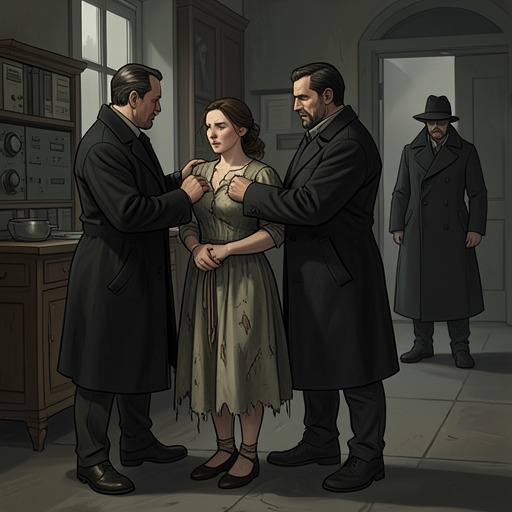
Madame directs Maud down toward the churchyard and treats its graves as an occasion for a grotesque game. She urges Maud to cross the stream, speaks of the dead as companions she will teach Maud to love, and pretends that Maud will see her die among the graves. She then gives herself the name Madame la Morgue and invents the figures Monsieur Cadavre and Monsieur Squelette as her supposed friends. Her theatrical performance culminates in a yell as she pushes back her wig and bonnet.
Maud resists and pulls her hand free rather than enter the churchyard. She steps back, while Madame laughs at what she calls Maud’s bad taste and presses her to hurry across. The scene establishes a consequential imbalance: Madame turns a solitary place into a stage for intimidation, but Maud’s refusal is a clear act of resistance. The episode also helps explain why Maud is later uneasy in Madame’s company, rather than presenting her fear as an abstract or unexplained suspicion.
Maud’s account and its uncertainty
When Maud later explains her fear to a visitor, she recalls that Madame left her alone across the stream after bringing her to Church Scarsdale. A young man, whom Maud describes as looking like a farmer’s son, stopped to speak to her despite her reluctance. She says he seemed amused by her distress and did not leave until Madame returned; Madame, in Maud’s recollection, showed little concern and laughed at her for being frightened.
The memory carries both an immediate personal consequence and a later plot significance. It helps account for Maud’s discomfort with Madame, and it supplies an early encounter that Maud eventually associates with Dudley. Yet the narrative does not initially secure that identification: Maud’s description is questioned, and the place’s remoteness makes the remembered episode difficult to verify. Church Scarsdale therefore holds the two sides of her account together—the experience of being left alone and frightened, and the uncertainty others use to discount what she says happened.
Dudley’s denial and Silas’s response
Much later, Maud tells her uncle that she met his son at Church Scarsdale, and also saw him with others at Knowl on the night the gamekeeper was beaten. Dudley denies ever having been at either place and claims he has never seen Maud. His assurance is strong enough to make Maud question whether she has mistaken him for someone else. The encounter at Church Scarsdale thus becomes evidence in a family confrontation, not merely a frightening memory.
Silas asks Maud to explain her recollections of Church Scarsdale and Knowl, then minimizes what she describes. He characterizes the churchyard episode as less alarming than she had expected and treats the gathering at Knowl as a drunken frolic, reasoning that the presence of a woman in a carriage meant no harm was intended. His interpretation turns Maud’s testimony into an occasion to defend Dudley’s character: he presents his son as someone who would openly boast of such an adventure rather than lie about it. The contrast between Maud’s remembered vulnerability and Silas’s dismissive reconstruction shows how the place’s events are filtered through competing interests.
Recurrence and narrative significance
Church Scarsdale recurs as part of the novel’s larger pattern of isolated places, uncertain evidence, and contested belief. During Maud’s childhood, a Swedenborgian account of what lies beyond a wall leads her to ask whether her dead mother has been taken away; the answer describes reaching home through the gate of death. This early religious conversation joins the landscape to bereavement and the possibility of an unseen world, although it is distinct from Maud’s later, concrete fear of entering the churchyard.
The novel also sets Church Scarsdale beside a different mystery: the apparently sealed room in which Charles Charke died. The reported evidence—an inwardly fastened window, a locked door, and no sign of entry—first seems to rule out another person’s access. In a later inquiry at Bartram-Haugh, however, Doctor Bryerly discovers concealed steel hinges in a window frame, revealing how an entrance could have been hidden. Church Scarsdale is not the scene of that discovery, but the two settings contribute to a shared narrative concern: appearances of isolation or impossibility can be challenged when concealed routes and disputed testimony come to light. The churchyard’s threshold, which Maud refuses to cross, remains a precise image of the broader uncertainties surrounding what she saw and what others are willing to believe.